

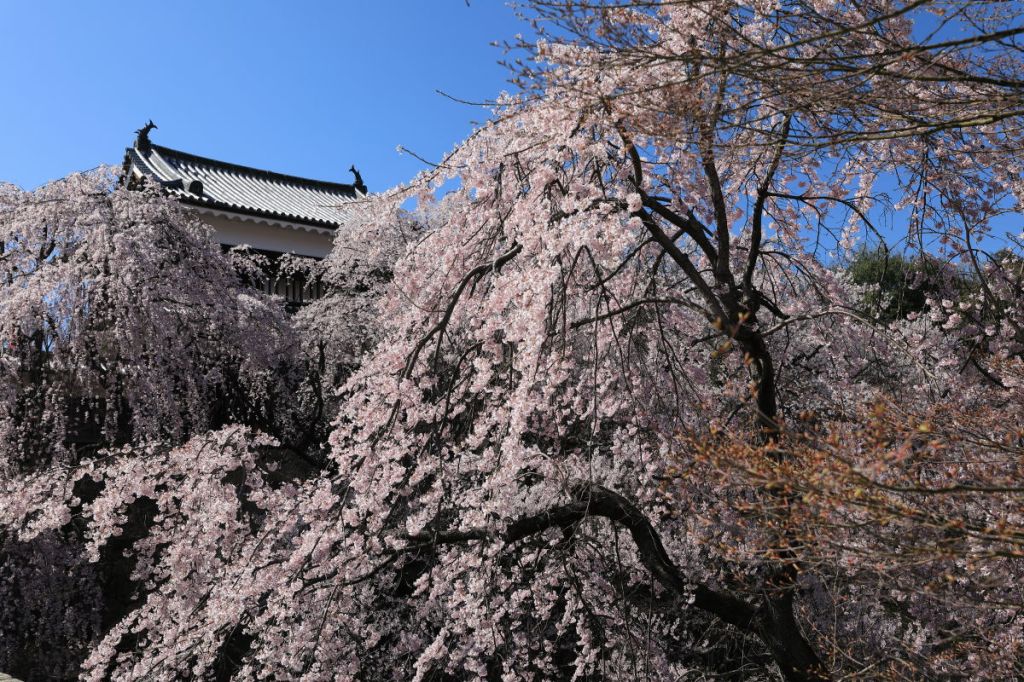
From Wednesday, April 10th, to Friday, April 12th, 2024, I traveled by private car to Bessho Onsen, located near Ueda City in Nagano Prefecture, and to Isawa Onsen in Fuefuki City, Yamanashi Prefecture. Having concluded my office worker role at the end of the previous month, I chose to indulge in a hot spring retreat to cleanse myself of the mental weariness of my office days.
(Itineary)
The total trip was about 500km: Home → Ueda Castle Senbonzakura → Bessho Onsen (overnight stay) → Suwa Taisha Shimosha Harumiya → Isawa Onsen (overnight stay) → Home.
April 10th (Wed)
I departed from home at 9:00, enjoyed a late breakfast at Miyoshi PA on the Kanetsu Expressway, exited at Ueda Sugadaira IC, and proceeded to Ueda Castle Ruins Park. Initially, we had dismissed the chance to view the cherry blossoms, as the Ueda Castle Senbonzakura Festival concluded on April 7th. However, this year’s bloom was postponed, lasting until the 14th, allowing us to witness the cherry blossoms at their peak. Arriving around 13:00, our first stop was the renowned soba eatery Kusabue (Ueda Castle Store), situated near Ueda Castle, where we savored some exquisite soba noodles.
The Ueda Castle Ruins Park and Cherry blossomes of Senbonzakura


Constructed in 1583 by Masayuki Sanada, Ueda Castle is renowned for twice repelling large Tokugawa forces, achieving notable battle successes, and its striking appearance during cherry blossom season. After the Battle of Sekigahara, the Tokugawa commandeered Ueda Castle and it fell into abandonment. However, the new lord, Tadamasa Sengoku, was granted shogunate approval to rebuild the castle. Subsequently, the Matsudaira clan took over, and the castle remained in use until the Meiji Restoration.
Following our stroll around the castle, we made our way to Bessho Onsen, Nagano Prefecture’s oldest hot spring with a 1400-year history, situated near the ruins of Ueda Castle. The spring’s weakly alkaline, simple sulfur waters leave a gentle impression and emit a subtle sulfuric scent. Our lodging for the night is Nanakusa no Yu, conveniently located near the spring’s source, Kitamukai Kannon. Despite its modest size of only 16 rooms, it has garnered high praise on the JTB booking site, which piqued my interest in staying there.

Upon our arrival at 14:30, we were escorted to our room where we discovered a basket brimming with more than five varieties of Japanese confections, including dorayaki and walnut yubeshi. After enjoying tea and sweets, we visited the bath on the top floor, the 6th. The indoor and open-air baths offered panoramic views of Shiodadaira, Mt. Asama, Mt. Azumaya, and Ueda city. The image below is captured from the inn’s website, showcasing the open-air bath.

For dinner, we opted for a Japanese Kaiseki meal at a restaurant, which included local sake, wine, and sparkling wine. The photo below shows only the appetizer, but the menu also featured today’s sliced raw fish, steamed pick conger and bamboo shoots in an earthenware teapot, Goto udon noodles with senmai shrimp, Saikyo-yaki style Ise sea bream, fried globefish with crackers, and grilled Shinshu premium beef on a ceramic plate. The waitress at the restaurant attentively served each dish. Although there were many dishes, each portion was small, making the quantity just right and the taste thoroughly satisfying..

The following morning, we returned to the same restaurant for breakfast. As depicted in the photo, our meal included rice prepared with solid fuel, miso soup, salad, and various side dishes. While not visible in the image, there was also a choice of main courses from the previous day: three kinds of salmon, salted mackerel, or hamburger steak. It was a delightful breakfast that provided a hearty start to the day with its array of side dishes.

My experience at the ryokan was marked by exceptional hospitality and meticulous attention to detail, leaving me thoroughly satisfied. Should the opportunity arise, I would be eager to visit again.
April 11th (Thur)
During the Kamakura period, the Shiodadaira area, encompassing Bessho Onsen, fell under the Hojo clan’s domain. The Shiota-ryu branch, initiated by Yoshimasa Hojo, established Shioda Castle as their stronghold. This region, often referred to as the “Kamakura of Shinshu,” saw the thriving of Kamakura Buddhism and Zen culture. Our first stop was the visitation of these historic temples and shrines.

Initially, I visited Kitamukai Kannon, located near my lodging. This hallowed site was established by Jikaku Daishi Ennin, the chief priest of Mt. Hiei’s Enryaku-ji Temple during the Heian period. Uniquely, its main hall faces north, a rarity in Japan. By visiting both Kitamukai Kannon and Zenkoji Temple, which faces south, one can pray for ‘The Land of Perfect Bliss’ and ‘Prosperity in This World,’ gaining divine blessings, it is believed.


Within the precincts stands a massive Aizen Katsura tree, believed to be over 300 years old, though some theories suggest it could be as old as 600 or even over 1000 years. It boasts a trunk circumference of 5.5 meters and is recognized as a natural monument. Inspired by this tree and the nearby Aizen Myoo-do Hall, Matsutaro Kawaguchi reportedly penned a novel titled “Aizen Katsura.” Subsequently, we visited Anrakuji, the most ancient Zen temple in Shinshu, established during the Kamakura period. Incidentally, the building to the left is Nanakusa no Yu, our accommodation. Conveniently, it featured a parking lot at the rear, which is where I parked.


Here stands the octagonal three-storied pagoda, constructed in 1289 and designated as a national treasure. Although it may appear to be a four-storied structure at first glance, the lowest roof is actually considered an eave, confirming its status as a three-storied pagoda.

We then proceeded to Jorakuji Temple, established in 825 as the principal temple of Kitamukai Kannon. The temple’s main hall features a thatched roof, and its front garden is adorned with a splendid pine tree, approximately 350 years old, its branches sprawling elegantly.


Next up is Bessho Shrine, situated close to Jorakuji Temple. Although the main shrine is modest in size, it offers a sweeping panoramic view of Bessho Onsen.


Following our visit to Bessho Onsen, we proceeded to the Ikushima Tarushima Shrine, an ancient and revered shrine situated at the heart of Japan, known for being a power spot. Its origins are obscure, but it is evident that it is a historical shrine held in high esteem by a succession of emperors since Heijo emperor in 806.


I departed from Shiodadaira and made a stop at Suwa Taisha Shimosha Harumiya, located in Shimo-Suwa Town.


Harumiya is also fine shurain like Suwa Taisha Shimosha Akimiya. Near Akimiya, I considered having lunch as there was a dining place close by. However, the options were limited on the shrine’s approach, so I decided to dine at Suwako SA, located right beside Okaya IC, before taking the Chuo Expressway towards Isawa for the hot springs.
This evening’s lodging is at Kagetsu-Stone Monument Inn. Upon arrival and a brief rest, I indulged in a bath. The spring’s quality is that of a simple alkaline hot spring, imparting a subtly slick sensation. The accompanying photo is a screenshot sourced from the official website, showcasing both an indoor and an open-air bath, each incorporating large stones.

The inn’s courtyard is equally stunning, featuring large stones and a pond where numerous colorful carp swim gracefully.


Tonight, we also enjoyed a delightful Japanese Kaiseki dinner.


April 12th(Fri.)
After breakfast and checking out at 9:30, I plan to return home. However, before doing so, I’ll first visit the Yamanashi Prefectural Museum to explore the area’s sights.


The special exhibition titled “300 Years of Fuji River Water Transport” details the significance of the Fuji River, at the confluence of the Kamanashi and Fuefuki Rivers, as a crucial logistics route linking Kai and Suruga with Edo and Osaka since the Edo period. Being one of Japan’s three major rapids, it has been the site of numerous accidents.
The permanent exhibition’s dioramas, which recreated the everyday lives and cityscape of the Edo period, were fascinating. Additionally, the staff in each exhibition room offered thorough explanations. The museum’s courtyard also features a stunning rock garden.

I was unable to visit Zenkoji in Shinano, so I decided to go to Kai Zenkoji Temple instead. Its origins can be traced back to Takeda Shingen’s worry that Shinano Zenkoji Temple would be destroyed during the Battle of Kawanakajima, which led him to establish Kai Zenkoji and restore the principal image of Zenkoji Nyorai. The Shichido Garan, built by Takeda Shingen, was consumed by fire in 1754, resulting in the rebuilding of the temple’s main gate and main hall in 1796.


The ceiling of the main hall of Kondo is a suspended ceiling, and two giant dragons are depicted on it. In the center, there is a ringing dragon that echoes when you clap your hands, and it is said to be the largest in Japan. Like Zenkoji Temple in Nagano, there is a “Kaidan Meguri”, and when you go down the stairs to the bottom of the main hall, a dark passage awaits you. There was a lock on the way, and it was said that touching it would bring good luck, so I touched it carefully.
As noon approached, we decided to dine at a restaurant near Chateau Katsunuma on our way home. We opted for French cuisine, seeking a change from the Kaiseki meals and soba we had been enjoying.


Feeling like I’ve overindulged, I chose the lighter course. Although peach wine was available as an aperitif, I decided on peach juice instead, as I was driving.


The price of 2,600 yen is quite reasonable.
I purchased red wine from the shop on the ground floor and bread from the bakery across the street, then enjoyed them at home. They were affordable and very tasty. I headed home feeling uplifted!
The trip lasted two nights and three days, yet I managed to stay at an excellent inn for a reasonable price during the weekdays. The weather was pleasant, the food was delectable, and I visited all the tourist attractions without any waste of time, making it an ideal trip.
 旅好き爺の旅行記
コメントを残す